


Reflections by Djuma Mumbere, Gemmology Expert, Sociopolitical Actor, Initiator and National Coordinator of the UBUNTU RENAISSANCE dynamic.
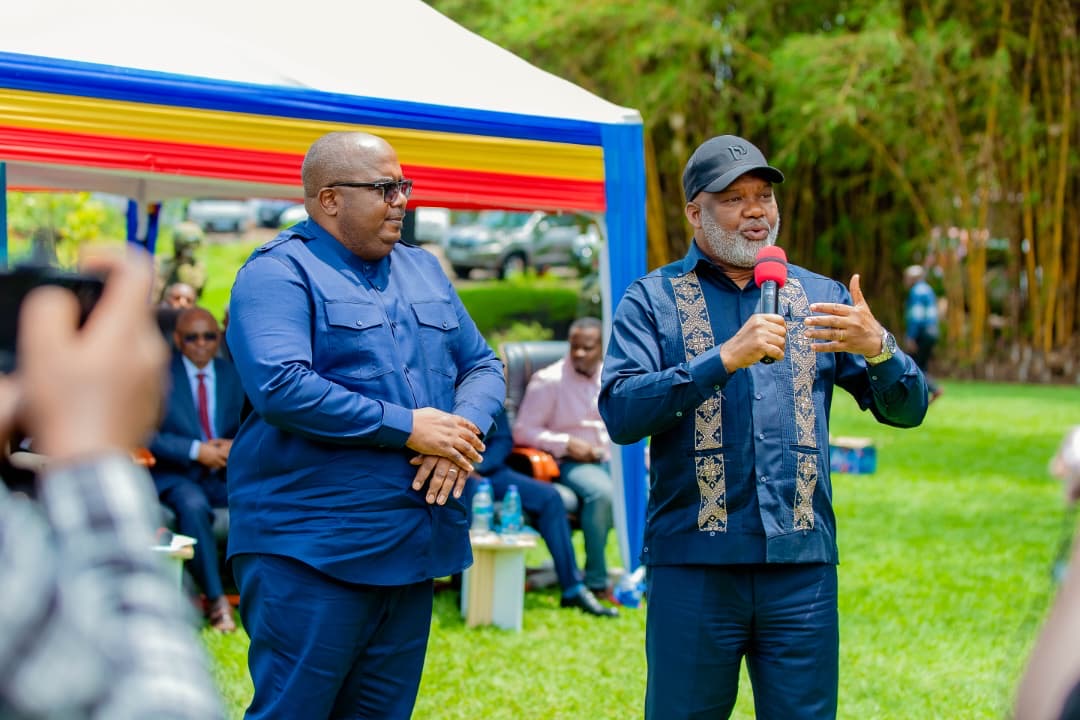
As part of my contribution to the search for sustainable peace in the eastern part of the Democratic Republic of Congo, I had the honor today to meet Mr. Corneille Nangaa, Coordinator of the Alliance Fleuve Congo (AFC), for an in-depth discussion lasting more than one hour, focused on the geological, economic, and strategic realities of the Great Lakes region.
During this meeting, several fundamental issues were addressed: the question of mineral resources, regional security challenges, the limits of current governance in the DRC, and the prospects for lasting peace based on regional cooperation and political responsibility.
As a gemology expert and National Coordinator of the UBUNTU RENAISSANCE movement, I believe it is time to open a serious, rational, and objective debate on the so-called “geological scandal” of Congo. For many years, this expression has been used as a political argument to explain nearly all the failures of governance in the country. Yet behind this emotional rhetoric lie far more complex realities that the Congolese people deserve to understand clearly and truthfully.

1. The Myth of “Survival Looting” and Political Manipulation
For decades, the natural resources of the Democratic Republic of Congo have occupied a central place in national political discourse. Recurrent wars, insecurity, and diplomatic tensions with neighboring countries are often presented as the direct consequence of an alleged exclusive greed surrounding Congolese minerals.
This oversimplified interpretation of the Congolese crisis has gradually become a political tool. It allows certain leaders to divert attention from the country’s real internal problems: poor governance, systemic corruption, embezzlement of public funds, weakened state institutions, lack of economic planning, and the inability to guarantee the security of the population.
Even today, the government of Félix Tshisekedi continues to use the war as the main justification for failures recorded in several essential sectors of national life. Budget overruns, weak infrastructure, and persistent social crises are frequently explained solely by the security situation.
However, this political communication strategy does not answer the true concerns of the people. It maintains a culture of permanent victimhood that prevents any serious examination of internal responsibilities.
It therefore becomes necessary to ask fundamental questions:
- Why do certain provinces far from conflict zones remain trapped in extreme poverty despite their immense wealth?
- Why do populations still lack drinking water, electricity, schools, and hospitals while the country possesses enormous mineral resources?
- Why are mining revenues not translated into concrete improvements in citizens’ living conditions?
These questions demonstrate that the Congolese problem cannot simply be reduced to external looting. The crisis is primarily linked to a deep failure of governance.
2. The Regional Geological Reality: A Debate Often Distorted
One of the greatest misconceptions maintained in Congolese public debate is the idea that the DRC is the only mineral power in the Great Lakes region and that neighboring countries depend exclusively on Congolese resources for their economic survival.
This claim does not withstand serious geological analysis.
The reality is that several African countries also possess important strategic resources.
Rwanda
Rwanda possesses recognized reserves of strategic minerals, including:
- coltan (tantalum),
- cassiterite (tin ore),
- tungsten,
- gold.
Despite its small territory, Rwanda has invested in structuring its mining sector, traceability systems, and mineral value chains.
Tanzania
Tanzania is among the leading mining powers in East Africa. The country possesses:
- significant gold reserves,
- diamonds,
- nickel,
- uranium,
- graphite,
- as well as the famous tanzanite gemstone, unique in the world.
This reality demonstrates that the regional economy does not rely exclusively on Congolese resources.

Kenya
Kenya also possesses:
- titanium,
- rare earth minerals,
- gold,
- limestone,
- as well as important energy and gas resources.
In addition, Nairobi has established itself as a regional hub for services, finance, and new technologies.
3. The Real Scandal: Poor Governance in Congo
The real geological scandal is not merely the existence of minerals. It lies above all in the inability of the Congolese state to transform these resources into concrete development for its population.
The Kasai Paradox
Kasai is one of the richest diamond-producing regions in the country. Yet infrastructure there remains extremely poor:
- impassable roads,
- limited access to electricity,
- chronic poverty,
- massive youth unemployment.
Yet Rwanda has never occupied this region. This clearly demonstrates that Congo’s problems cannot be explained solely by foreign interference.
Maniema: Mineral Wealth and Isolation
Maniema possesses major mineral resources, including:
- coltan,
- cassiterite,
- gold.
However, the province remains highly isolated. Roads are severely degraded, and local populations continue to live in precarious conditions. Once again, this situation exposes the weaknesses of national governance.
Equateur: Abandoned Ecological Wealth
The Equateur Province has enormous potential in:
- forestry resources,
- biodiversity,
- agriculture,
- carbon credits.
Despite this, the absence of adequate road infrastructure prevents meaningful economic development. Local populations remain marginalized even though the region could significantly contribute to national economic recovery.
The Lualaba and Haut-Katanga Paradox
The provinces of Lualaba and Haut-Katanga produce a substantial share of the world’s copper and cobalt. These minerals are essential to modern technological industries, especially electric batteries.
Yet:
- local populations often live in poverty,
- social infrastructure remains inadequate,
- environmental pollution continues to increase,
- profits benefit mainly a political and economic elite.
This contrast illustrates the failure of the current natural resource management model.
4. Persistent Insecurity: A Leadership Crisis
The cities of Beni, Butembo, and several territories in Ituri continue to suffer deadly violence despite officially being under government control.
Massacres continue to occur regularly:
- attacks against civilians,
- kidnappings,
- village burnings,
- machete killings.
Faced with this situation, many questions remain unanswered:
- Why is the state failing to sustainably protect its population?
- Why do security mechanisms remain ineffective despite large budgets?
- Why do perpetrators continue to operate with such ease?
The truth is that no lasting peace can be achieved without a profound reform of political and security leadership.
The Congolese crisis is not only military. It is also institutional, diplomatic, and moral.
5. The Need for Regional Cooperation
Our neighbors will remain our neighbors forever. No people can change geography. The long-term stability of the Great Lakes region will therefore necessarily depend on intelligent cooperation among states.
Hatred of neighbors, stigmatizing rhetoric, and constant accusations will never build peace.
On the contrary, sustainable peace requires:
- responsible diplomacy,
- regional economic cooperation,
- coordinated border management,
- transparent mechanisms for managing resources,
- mutual respect among peoples.
The region’s security challenges are complex and require collective solutions rather than a permanent policy of scapegoating.
6. UBUNTU RENAISSANCE’s Call for a Civic Revolution
In response to this situation, the UBUNTU RENAISSANCE movement calls for a revolution of consciousness and civic awakening.
This revolution does not necessarily mean violence or taking up arms. It primarily means:
- defending the truth,
- promoting knowledge,
- demanding political accountability,
- encouraging civic participation,
- rejecting emotional manipulation.
The Congolese people must learn to analyze facts with clarity and move beyond simplistic narratives based solely on fear and emotion.
The future of the DRC will depend on its ability to build:
- strong institutions,
- an independent judiciary,
- a diversified economy,
- an effective republican army,
- a credible regional diplomacy.
7. Conclusion: Toward a New Vision for the DRC
The Democratic Republic of Congo deserves better than permanent division, hate speech, and political manipulation.
The real struggle today is the struggle for good governance, transparency, and accountability of leaders before the people.
Congo’s renewal will not come through permanent victimhood or hatred of neighboring countries. It will come through:
- truth,
- competence,
- justice,
- regional cooperation,
- and the emergence of leadership capable of placing the interests of the people above personal political interests.
I therefore call on all Congolese citizens, particularly the populations of Beni, Butembo, and Ituri, to remain vigilant, united, and mobilized in defense of their rights, their security, and their future.
The DRC possesses the human, natural, and intellectual resources necessary to become a major African power. But this requires profound transformation in governance and a break with the political practices that have fueled crises for decades.
Hon. Djuma Mumbere
Djuma Mumbere
Gemology Expert Sociopolitical Actor
Founder and National Coordinator of the UBUNTU RENAISSANCE Movement
UBUNTU RENAISSANCE is a citizen-driven, scientific, and strategic movement dedicated to advocacy, awareness-raising, and mobilization based on facts, knowledge, and truth.
Its mission is to promote “a rigorous understanding of the natural resources of the Great Lakes region, to highlight their potential as a lever for cooperation, shared prosperity, and lasting peace, and to contribute to the renewal of the Democratic Republic of the Congo.”
UBUNTU RENAISSANCE seeks to raise awareness, encourage an objective reading of the region’s geological, economic, and geopolitical realities, and strengthen citizens’ ability to distinguish facts from simplistic narratives.
The movement strives to demonstrate that natural resources, when managed with transparency, competence, and responsibility, can become a powerful instrument for development, stability, and regional integration.
Through research, education, advocacy, and civic mobilization, UBUNTU RENAISSANCE works to promote governance grounded in truth, accountability, and the common good, with the aim of turning natural wealth into a source of peace, dignity, and prosperity for the peoples of the region, particularly for the Democratic Republic of the Congo.
Kivu News Today






Leave a Reply